The statistics
This page is the reason dedrift exists. Every claim below is enforced by a test in CI; where a guarantee is approximate or a procedure is heuristic, the docs say so plainly.
The detector battery
One primary test per channel enters the FDR pool and can alert; redundant tests run as corroboration only, so multiplicity is spent on distinct questions rather than three answers to the same one.
| Channel | Primary test | Materiality gate | Corroboration |
|---|---|---|---|
| Location / shape | Two-sample Kolmogorov–Smirnov | KS statistic D ≥ 0.15 (sup-norm CDF distance — catches shape changes with equal means, where Cohen's d ≈ 0). D is also the reported effect for this channel, so what gates is what you read; Cohen's d appears on the Welch corroboration row as a location diagnostic | Anderson–Darling, Welch's t (raw p shown, never alert) |
| Tool-call order | Two-sample KS on tool_order_inversions, like any other scalar |
Same scalar gates (D ≥ 0.15, …) | — |
| Dispersion | Brown–Forsythe (Levene, median-centered) | Robust dispersion ratio (mean abs deviation from the median) ≥ 1.5× either way | — |
| Tail | P95 permutation test (pooled labels, seeded, add-one p) | Relative P95 shift ≥ 10% | — |
| Rates | Two-proportion z, continuity-corrected | Percentage-point thresholds (refusal ≥ 2 pp, …; refusal is pattern-matched phrasing — see fine print) | — |
| Semantic | MMD² (RBF), seeded permutation null ≥ 500 perms, pooled median-heuristic bandwidth (permutation-invariant, so the kernel is fixed across relabellings) | Auto-calibrated MMD² floor, same bandwidth as the observation | — |
| Sequential per-cycle means | Page–Hinkley | Flag + onset localizer, not a p-value | — |
| Industry heuristic | PSI, 10 bins frozen from golden | Labeled heuristic (0.1 / 0.25); never a test; emitted only above its validity scale (see fine print) | — |
The tool-call-order channel takes the battery to m ≈ 336 — and the
headline null is family-wise in m.
tool_order_inversions counts Kendall-tau inversions of the tool-call
name sequence against its alphabetical sort — 0 for records with fewer
than two calls. Counts and schema validity say nothing about tool-call
order; this is the only Tier-1 channel that sees workflow reordering,
and a battery without it is blind to order reversal by construction (the
independent audit measures 0/30 for such a battery). The alphabetical
reference is arbitrary by
design: a stable agent's inversion count is stationary under any fixed
convention, and the tests compare distributions, so only changes in
ordering register. The scalar puts the primary pool at
m ≈ 336 at the default suite — and the any-alert rate is family-wise:
it grows with m even when every per-test FDR statement is valid, so the
headline null below is always stated at its battery size.
The gating pipeline — order matters
- Run all tests; collect p-values. PSI and Page–Hinkley produce flags, not p-values, and never enter step 2. Corroboration tests never enter it either.
- Benjamini–Hochberg adjustment at q = 0.05 across the primary tests in the check — one multiplicity family spanning both baselines.
- Survivors pass a materiality gate (per-channel thresholds in the table above) — all configurable. Corroboration tests carry no materiality verdict at all: the gates are defined on the primary effect scales, and e.g. the Anderson–Darling statistic is not commensurable with a sup-norm distance, so labeling it "material" would be meaningless.
- Only primary tests passing both gates become alerts. Everything else appears in the report as "significant, below materiality", "not significant", or "corroboration".
Alert fatigue kills monitoring tools; the double gate is deliberate.
This is a prioritization policy, not a formal practical-null FDR procedure. Ordinary BH needs independence or PRDS, which is not established for this dependent battery. Filtering equality-null rejections by an observed effect does not inherit FDR control for “effect is inside the materiality band.” The default simulation below is the evidence offered here; near-threshold alerts need confirmation and production suites need their own calibration.
Calibration is enforced, not asserted
The simulation harness generates agent logs with known ground truth, and CI runs (on every commit and inside the release pipeline):
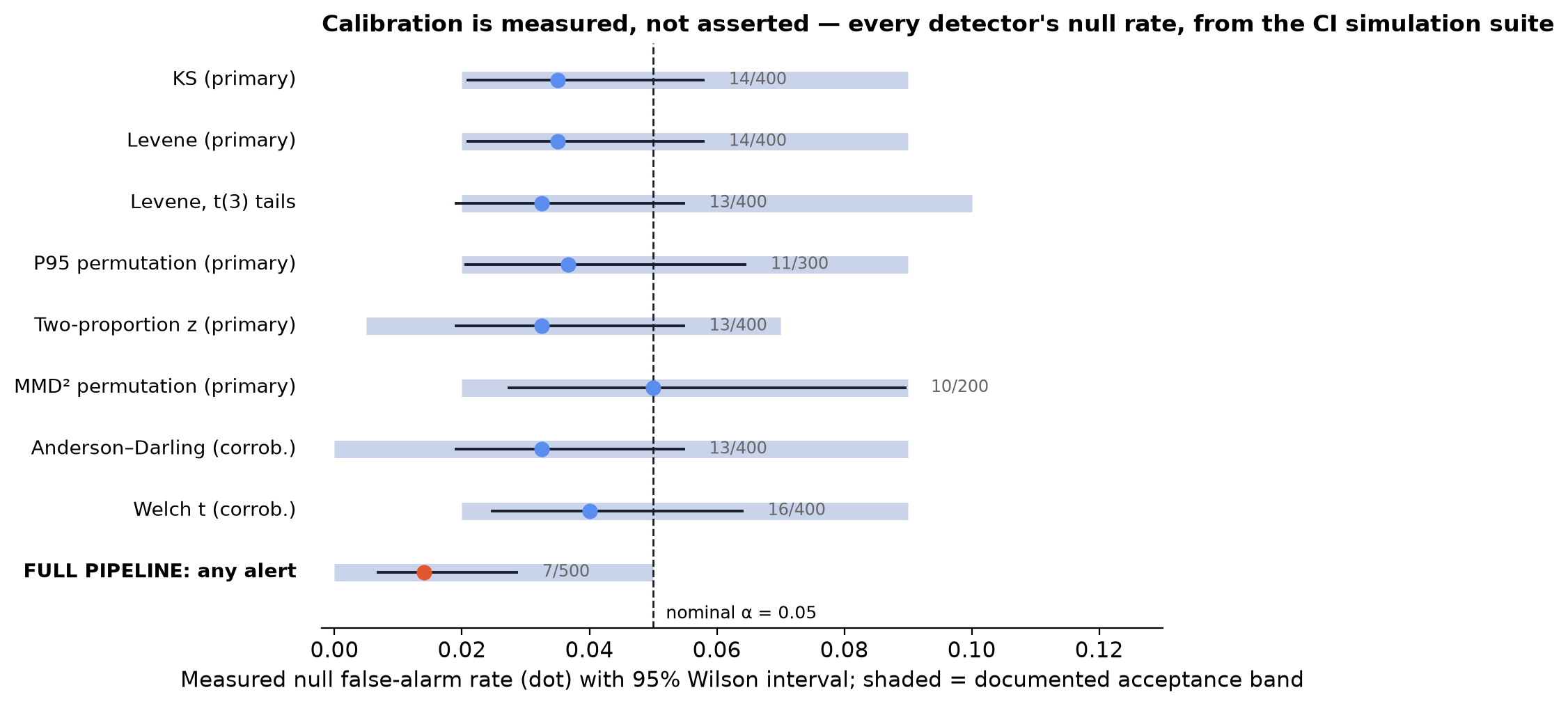
- Per-detector null calibration — every p-valued detector in the battery (KS, AD, Welch, Levene — including under heavy t(3) tails — the P95 permutation test, the two-proportion z, and MMD) has its false-alarm rate measured over hundreds of null simulations against a stated acceptance band.
- Pipeline-level null calibration — 500 seeded stable-agent runs through the full pipeline; the per-check probability of any alert must have a Wilson 95% upper bound below 0.065. The measured rate is 16/500 = 3.2%, Wilson upper 5.1%, at m ≈ 336 primaries. The band sits above the per-test nominal for exactly the battery-size reason above: the any-alert rate is family-wise, and a gate frozen at a smaller battery's rate — the same study measures 10/500, upper 3.6%, at m ≈ 300 primaries — would fail a correctly behaving m ≈ 336 battery. (A pass/fail over 20 runs — the naive version of this gate — would pass 39% of the time even with a true 10% alert rate; 500 runs with a reported bound is the honest version of the claim.) Scale caveat: these runs use 12 canaries × 5 repetitions, not the 18 × 7 default, for CI runtime. Under a calibrated null the alert rate is approximately scale-free, but the materiality gates interact with N — so the bound is established, and claimed, at that stated scale.
- Power checks — injected shifts (mean, variance, distribution swap, equal-mean shape change, scripted model swap) must be detected at documented rates, with correct config attribution.
Detection power: the honest table
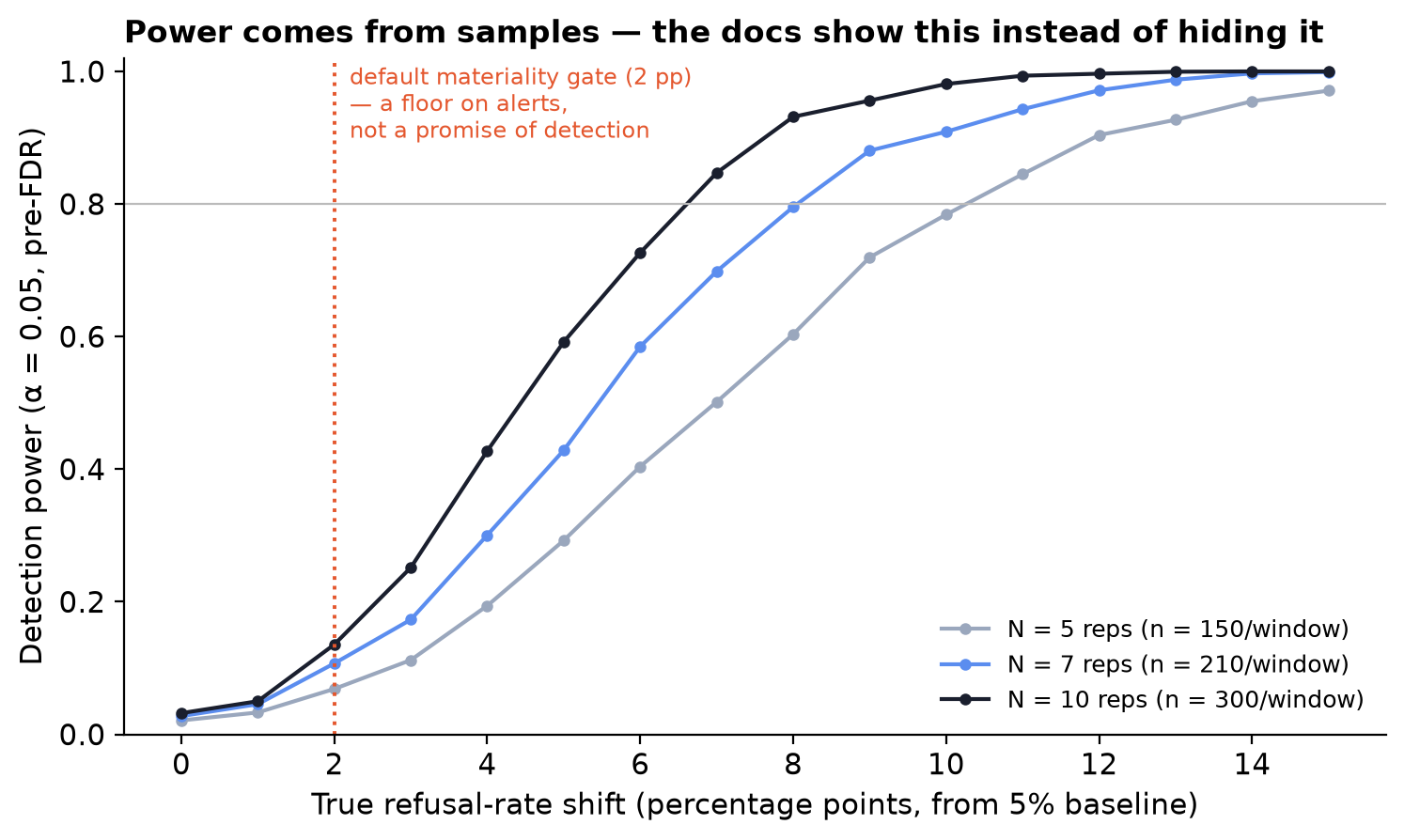
Power comes from samples, and canary suites are small. For a rate signature at a 5% baseline in a family of 30 canaries (two-sided α = 0.05 per test, before FDR, which reduces power further):
| Repetitions N | n per window | +2 pp | +5 pp | +10 pp | +15 pp |
|---|---|---|---|---|---|
| 5 | 150 | 0.07 | 0.28 | 0.78 | 0.97 |
| 7 (default) | 210 | 0.11 | 0.42 | 0.91 | 1.00 |
| 10 | 300 | 0.13 | 0.60 | 0.99 | 1.00 |
A 2 pp refusal shift is essentially undetectable at this scale. The default 2 pp materiality gate is a floor on what may alert, not a promise of what will be detected. If small shifts matter, grow the relevant canary family or raise N.
Cycle effects
Balanced windows give equal composition. Exchangeability needs more: the per-record law must be constant across cycles, which is strictly stronger than "nothing in the configured stack changed". A hosted model varies within a fixed version alias, and the reference pools several cycles against a current window of one, so a shared per-cycle offset shows up as location and dispersion movement no record-level two-sample test can distinguish from drift.
Measured on stable agents with a latent per-cycle offset of magnitude σ —
per-check false-alert rate with Wilson 95% intervals, audit-harness scale
(30 canaries × 7 reps, 3-cycle golden), all three columns measured on the
current build. Each project contributes five checks, so the denominators
below are 300 checks at σ = 0 and 200 above it for the record-level
battery (detection.cycle_effect = "off", the default), 150 for auto,
and 100 for auto + persistence=2:
| σ | record-level battery (default) | cluster-aware (auto) |
auto + persistence = 2 |
|---|---|---|---|
| 0.00 | 3.0% [1.6, 5.6] — 9/300 | 3.3% [1.4, 7.6] — 5/150 | 0.0% [0.0, 3.7] — 0/100 |
| 0.05 | 36.5% [30.1, 43.4] — 73/200 | 34.0% [26.9, 41.9] — 51/150 | 6.0% [2.8, 12.5] — 6/100 |
| 0.10 | 71.0% [64.4, 76.8] — 142/200 | 64.0% [56.1, 71.2] — 96/150 | 31.0% [22.8, 40.6] — 31/100 |
| 0.15 | 89.0% [83.9, 92.6] — 178/200 | 81.3% [74.3, 86.8] — 122/150 | 47.0% [37.5, 56.7] — 47/100 |
| 0.25 | 98.5% [95.7, 99.5] — 197/200 | 94.0% [89.0, 96.8] — 141/150 | 66.0% [56.3, 74.5] — 66/100 |
Each cell is the observed rate k/n with its Wilson 95% interval, and the
counts are printed so the rate can be checked against them.
(Two earlier revisions of this table are superseded. A pre-tool_order
build measured the record-level column at 2.3% / 33.5% / 70.8% / 87.5% /
97.8%; the rise is expected rather than noise, since the any-alert rate is
family-wise and tool_order_inversions takes the battery from m ≈ 300 to
m ≈ 336 primaries. Separately, every cell here was previously printed as
the centre of its Wilson interval rather than the observed k/n. The
centre is shrunk toward one half, so 0/100 read as 1.8% and 197/200 as
97.6%. The counts above are the measurements.)
At the CI scale (12 × 5, 500 runs, σ = 0) the modes measure 16/500 (3.2%, upper 5.1%) off and 19/500 (3.8%, upper 5.9%) auto — consistent with the harness-scale σ = 0 row.
The correction (detection.cycle_effect = "auto", opt-in) engages per
channel when the estimated intraclass correlation ρ crosses
detection.cycle_effect_icc (default 0.02). ρ is estimated from history
cycles only — never the cycle under test — on the log scale for positive
channels, and is capped at 0.15 so a drifting history cannot inflate the
estimate. On quasi-continuous channels, shape is tested by KS on
within-cycle-standardized values (a shared per-cycle offset cancels
exactly, so record-level power survives), disjoined with a
design-effect-inflated Welch location test and combined by Bonferroni-min,
which is valid under any dependence of the two members. Rate channels
switch to a design-effect-inflated two-proportion z. Dispersion and P95
move to Student-t summaries over per-cycle statistic values — cycle, not
record, is the unit under clustering — with discreteness guards that keep
the record-level p-value when the per-cycle series is near-constant. When
a channel engages, the corrected p replaces the record-level one (each
member is valid in both regimes, so the replacement is never
anticonservative); engagement is reported per channel in the check report.
Read the ladder plainly: the correction reduces but does not restore
calibration under wobble, and detection.alert_persistence = 2 — an
alert must repeat on a fresh current cycle before it fires — roughly
halves the residual again. Neither reaches nominal at canary scale, and
that limit is information-theoretic: a per-cycle offset at these sample
sizes is a real distributional change, not noise a record-level test can
see through. The 16/500 headline is measured at σ = 0 and describes that
regime only. Pinned or self-hosted models: leave the default off. For
mildly wobble-prone hosted models the better option is anytime-valid
mode, whose observed ever-alert rate stays within its
lifetime budget under iid wobble up to σ = 0.25 (measured 8/500;
persistent AR(1) offsets at σ = 0.25, φ = 0.9 exceed it at 7.2% — the
published boundary). But its guarantee lapses earlier than its alert
rate does — the e-value property is already unresolved at σ = 0.10 — so
above that magnitude neither path is covered by a bound, and auto +
alert_persistence = 2 is the configuration whose behaviour is measured
there, at the rates above.
The correction is bought with power — detection within 3 post-drift checks, drift injected at cycle 5, audit harness (record-level cells at 30–60 reps, cluster-aware cells at 10–20; small-n, stated rather than smoothed over):
| injected shift | record-level (off) |
cluster-aware (auto) |
|---|---|---|
| gross model swap, multi-channel | 30/30 | 10/10 |
| output length ×1.10 (d ≈ 0.77) | 31/60 (52%) | 8/20 (40%) |
| refusal +20 pp | 24/60 (40%) | 4/20 (20%) |
| variance only | 43/50 (86%) | 18/20 (90%) |
| shape skew, moments matched | 14/50 (28%) | 6/20 (30%) |
The gross swap is certain under either battery; moderate single-channel shifts are where the cluster-aware battery pays. Tool-call order reversal is the order channel's own measurement: 8/20 first-check channel alerts in the same harness — at a scale where "detected" means about two first checks in five — while a battery without the channel measures 0/30, blind to order by construction. That hole is what the channel exists to close. (This probe was rerun at 20 replicates for the full adversarial matrix; the 5/10 published with the 0.4.0 release notes was the earlier 10-replicate run and is superseded.)
Fine print, stated plainly
- The 500-run pipeline bound covers the structural channels only. Embeddings are excluded from those runs for runtime, so the semantic channel (family MMD and semantic displacement) has per-detector calibration but no pipeline-level measurement — and that is the channel carrying the largest effect in the case study. The gap is material and stated here rather than left to be inferred from m = 336 versus m = 384.
-
Suppressed evidence fails closed. A fully suppressed check reports
NO VALID COMPARISON; partial suppression reportsPARTIAL COVERAGE. Both return CLI exit 3, never the green exit 0. -
Balance is checked; exchangeability is measured, not assumed. Every check verifies this per (baseline, family): if a canary's records vanish from one window (a timeout, a partial run, a suite edit), the family mixture shifts and KS would fire on a missing-data artifact — so the comparison is suppressed and reported as COMPOSITION MISMATCH instead of drift. Power against shifts confined to a few canaries remains lower than for family-wide shifts. Exchangeability across cycles is the stronger requirement, and its measured failure modes — with the cluster-aware correction and its costs — are in Cycle effects above.
-
The guarantee on this page is per check, not per lifetime. Everything above bounds the probability that one check on a stable agent raises an alert. Monitoring runs continuously, and expected counts add regardless of how checks depend on each other (linearity of expectation; only the "at least one" probability needs independence). At the measured 3.2% per-check rate, a stable agent checked hourly accrues roughly 0.8 false alerts per day, ~23 per month (720 × 0.032). BH adjusts multiplicity within a check under its assumptions; nothing in the batch machinery controls accumulation across sequence of them.
Sequential control exists: anytime-valid mode replaces the per-check statement with a lifetime one — measured 2 false alerts in 500 stable-agent runs of 2000 cycles each (0.4%, Wilson upper 1.5%), against 100% for this path on identical histories. It is not the default, because it buys that guarantee with detection power: a +2 pp shift stays undetectable (0/100) and +10 pp is caught in 89/100 runs, at a median of 50 cycles. Both figures are on that page. If you stay on the fixed-sample path, the honest operating advice is unchanged — treat one alert as evidence to investigate rather than an incident, require persistence across consecutive cycles before paging anyone (
detection.alert_persistence = 2makes that the checker's semantics), and choose your check frequency knowing the arithmetic above. - Where the KS gate binds. The two-sample critical value at raw α = 0.05 is D_crit ≈ 1.36·√((n+m)/(n·m)). For equal arms the default gate (D ≥ 0.15) sits below D_crit until n ≳ 165 per arm — and BH only raises the bar. At typical per-family scale (say 21 current vs 105 pooled reference, D_crit ≈ 0.32) significance is therefore the stricter filter, and the KS gate cannot be the one that fires; its job is to stop trivially significant D from alerting at large n. A config-aware test recomputes both claims from the shipped default, so a threshold change that breaks this description fails CI. - The flag channel (Page–Hinkley, PSI) is uncalibrated and carries no multiplicity control — treat flags as diagnostics, never as alerts. PH runs on every (family, signature) stream (48 at the measured scale: 8 scalar signatures x 6 families), so per-stream rates compound: the 500-run null study measures, at the 48-stream battery, 69.8% of stable checks showing at least one flag (per-stream rate 2.7%, Wilson [2.5%, 2.9%] over 24,000 draws; 1−(1−0.027)⁴⁸ = 0.73 against the observed 0.698 — the residual gap is the streams sharing records). That number is printed here deliberately — flags never alert, they exist to localize onsets for attribution, and the report labels them as such. Cross-stream correction for the flag channel is on the roadmap. - PSI is refused where it cannot mean anything. PSI between two finite samples of the same distribution is not zero — to first order E[PSI] ≈ (B−1)·(1/n_ref + 1/n_cur) — and that asymptotic figure is itself optimistic: simulating the shipped implementation at (30, 10) gives a measured E[PSI] of 3.10, with PSI calling unchanged data a "major shift" 100% of the time. At canary scale (10 bins, tens of records) exceeds the 0.25 "major" folk threshold from sampling noise alone; before this guard, PSI flagged 100% of stable checks. The pipeline therefore emits PSI only when its null expectation is below half the "moderate" threshold (roughly n ≳ 360 equal-arm samples). PSI remains what it always was — a large-sample production-traffic index — and simply does not pretend to work below its domain of validity. - The refusal signature is pattern-matched phrasing, not a behavior class. The extractor matches refusal wording; a model that paraphrases its refusals can move the measured rate in either direction while true refusal behavior moves the other way — the independent audit measured a −27 pp change in the measured rate on a +20 pp true shift toward paraphrased refusals. Treat the alert's direction as a pointer to read the outputs, not as a verdict on what the model is doing. - Anderson–Darling and Welch are corroboration, not evidence. They test the same location/shape hypothesis as KS on the same data; admitting them to the FDR pool would roughly double m — halving every BH threshold — for no informational gain. Their raw p-values are printed for context and can never alert. (AD's p is additionally capped by SciPy's asymptotics to [0.001, 0.25].) - BH is used without a PRDS claim. PRDS is not available here: Dobriban (2026, arXiv:2607.12208) constructs correlated two-sided Gaussian p-values for which BH provably exceeds its nominal level, disproving a twenty-year-old conjecture that would otherwise have covered positively correlated two-sided tests. Our primaries are two-sided and computed on shared data — the exact configuration. The pipeline-level measured alert rate is therefore the operative guarantee for the default path; Benjamini–Yekutieli is on the roadmap for users who want a theorem, and--inference anytimeuses e-BH, which holds under arbitrary dependence. - Page–Hinkley (λ = 12, δ = 0.3 in robust-scale units, centre and scale estimated causally from an expanding window of data strictly before each step): the idealized null crossing bound is ~0.15% per stream, but because centre and scale are estimated from few observations the measured rate is 8.5% per stream on 30-cycle histories and 11.3% on 60-cycle ones (8000 draws). The causal estimation is load-bearing: an estimator that standardises with the whole stream, including cycles after the alarm, reads its own future and reports a falsely reassuring rate near 1.5%. This is why PH is a labelled diagnostic that can never alert. Two edge cases are engineered explicitly: a missing (family, cycle) would reindex the stream with NaN from which the running mean never recovers, so streams mask to the family's observed cycles; and near-constant discrete streams can produce absurd statistics (~2.6e15), held at ~0 by a scale floor at the window's floating-point resolution. PH alarms localize onsets for attribution; they never alert: only primary tests can. - MMD² materiality floor is auto-calibrated per (baseline, family) as the 95th percentile of MMD² between pairs of the baseline's own cycles — an empirical null from known-same-distribution data. With fewer than five reference cycles the auto-floor isUNCALIBRATED; MMD remains visible but cannot alert. The config accepts an explicit non-negative override. - Permutation resolution is sized for the BH family. Add-one Monte Carlo p-values have minimum1/(B+1). A configuredB=500cannot reach the rank-one BH cutoff in a 336-test family, so the checker automatically raisesBto at leastceil(m_upper/q)-1and records both configured and effective counts. P95 permutations are streamed in bounded-memory chunks. - Reproducibility. All randomness is seeded; permutation seeds are recorded in the report. Same logs + same config ⇒ the same report up to the recorded check timestamp: every statistic, p-value, effect, flag, and verdict is byte-identical; the timestamp line is the sole run-dependent field.