Demonstration: a silent model swap, caught in one cycle
Simulations prove calibration. This page shows what a check looks like when the ground shifts — a scripted silent model swap you can regenerate end to end with four commands. Every number below is the output of those commands on the current build.
The setup
The synthetic agent (dedrift sim) runs a frozen suite of 30 canaries
across six behavioral families — happy-path, edge-case, refusal-boundary,
tool-heavy JSON tasks, adversarial injections, long-context — at 7
repetitions per cycle (210 records per cycle). Tier-2 semantic signatures
use the zero-dependency pinned hash embedder.
dedrift init
dedrift embedder pin hash
dedrift sim --cycles 8 --change-cycle 7   # scripted swap at the 8th cycle
dedrift baseline set --first 3            # golden = cycles 1–3
The scripted swap changes the model identifier from simmodel@v1 to
simmodel@v2 — same prompt, same canaries, same tooling — with the
classic silent-degradation profile: longer outputs, higher refusal and
format-error rates, a thicker latency tail. The only trace visible to the
system is a changed configuration fingerprint. Nobody told the detector
anything.
The verdict
$ dedrift check
Current cycle: cycle-0007
Overall: DRIFT DETECTED
Sudden (vs rolling 4 cycles): DRIFT DETECTED
Cumulative (vs golden 3 cycles): DRIFT DETECTED
Alerts: 124 (BH-adjusted equality tests q=0.05, observed-effect gated)
  [golden] adversarial/output_chars ks: effect=+0.762, p_adj=2.42e-14
  [golden] adversarial/output_words ks: effect=+0.771, p_adj=8.97e-15
  [golden] adversarial/semantic_displacement ks: effect=+0.390, p_adj=0.002136
  [golden] adversarial/tokens_out ks: effect=+0.676, p_adj=7.13e-11
  ...
Both baselines fired on the first post-swap check. Effects are reported on the scales they were gated on: output-length KS statistics up to D = 0.93 (the distributions barely overlap), semantic displacement D ≈ 0.4–0.5 on the hash embedder, and latency dispersion up ~2.1× on the robust mean-absolute-deviation scale.
How these effects are measured — and why MMD is silent here
The semantic centroid is fit on reference records alone, so displacement is an out-of-sample score, and latency dispersion is the robust mean-absolute-deviation ratio the test is computed on, not a variance ratio.
The demo freezes a three-cycle golden baseline, and the MMD noise floor requires five reference cycles. The floor is therefore unavailable here, so MMD is diagnostic-only and cannot alert — that fail-closed behavior is deliberate: three pairwise values cannot calibrate a materiality floor. Use at least five known-good golden cycles or configure an externally justified floor.
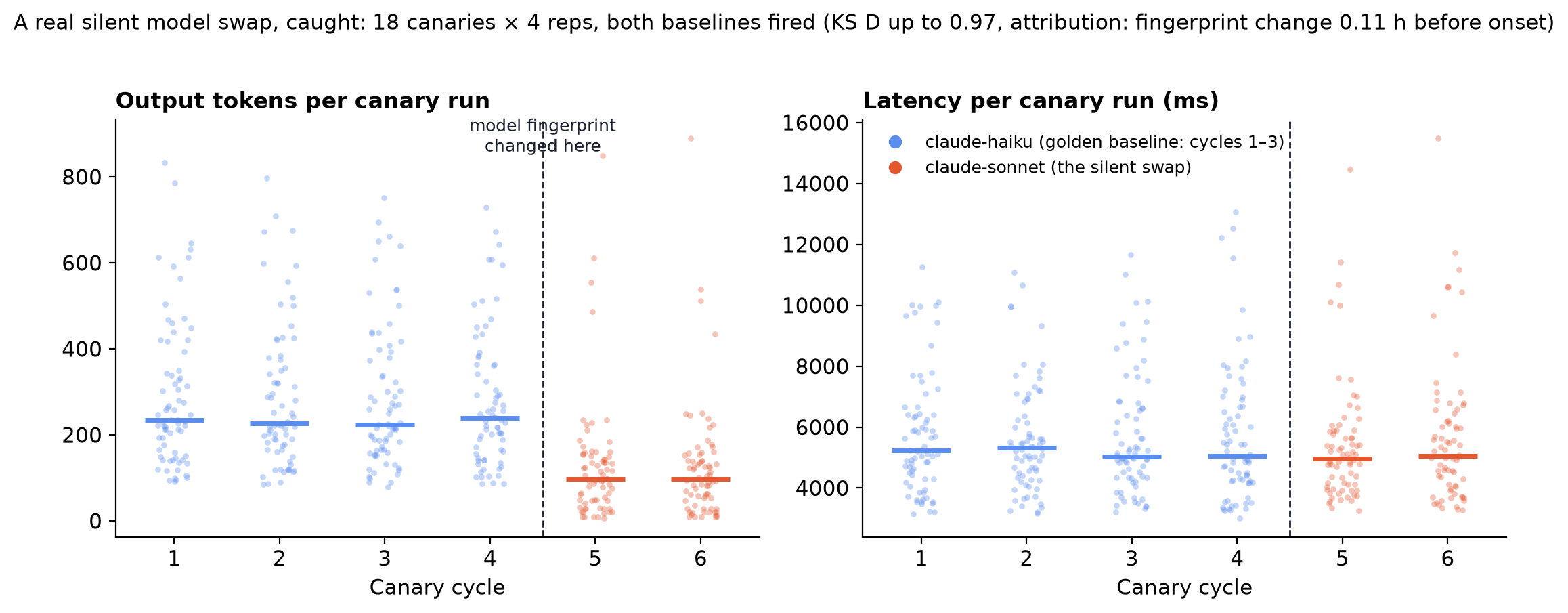
That right-hand panel is why dedrift tracks variance and P95 alongside means: agents often go erratic before they go wrong on average.
The attribution
Every alerting signature group was correlated with the recorded config events:
adversarial / output_words — drift onset ≈ cycle
cycle-0007. Nearest preceding config event: model fingerprint change, 0.0 h before onset. 21 other signature group(s) shifted in the same window.
Twenty-one signature groups co-shifting in one cycle, right after a fingerprint change, is what a configuration change looks like — as opposed to a single family decaying on its own. The report says "consistent with", never "caused by"; that's a design rule. Events that occur after the estimated onset are never described as preceding it — they are labelled weak evidence instead.
Honest imperfections
- With eight cycles of history the Page–Hinkley change-point localizer is at the edge of its usable range, and a couple of signature groups localize the onset a cycle early; those attributions are labelled as weak evidence rather than preceding-onset. The estimate's measured false alarm behavior is documented in Statistics.
- This is a scripted synthetic agent: it demonstrates detection and attribution mechanics, not production prevalence. Evidence on real production agents is what the design-partner program collects — apply from the pricing section if you run one.
Reproduce it
pip install dedrift
dedrift init && dedrift embedder pin hash
dedrift sim --cycles 8 --change-cycle 7 && dedrift baseline set --first 3
dedrift check
Runs in about a minute. The numbers above regenerate bit-for-bit (the sim
is seeded), and dedrift report renders the full markdown report with the
attribution table.